
RNH Joins Platform of European Memory and Conscience

In the Hague 12 November 2013, the application of RNH, the Icelandic Research Centre for Innovation and Economic Growth, to join the Platform of European Memory and Conscience was accepted. Formed in 2011 in response to the resolutions by the European Council and the European Parliament in memory of victims of totalitarianism, Nazism and communism, the Platform held its annual meeting in the Hague. At the meeting, Professor Hannes H. Gissurarson gave a presentation on the joint RNH-AECR project, “Europe of the Victims: Remembering Communism”. He explained the two reasons why the emphasis was on communism rather than Nazism. First, the evil of Nazism had firmly entered the Western consciousness at the end of the 2nd World War, when photographs and films of the extermination camps were shot and shown. In the second place, the Icelandic communist movement was relatively strong, and still had its defenders.

Professor Gissurarson gave an account of the major events in the project. Many distinguished scholars and authors had visited Iceland: Professor Bent Jensen, the foremost Danish author on the Nordic communist movement, Professor Niels Erik Rosenfeldt, a Danish specialist on the Comintern and the author of a thorough examination in two volumes of its secret apparatus, Professor Oystein Sorensen, a Norwegian expert on totalitarian ideology, Professor Stéphane Courtois, editor of the seminal 1997 Black Book of Communism, Anna Funder, Australian author of much-acclaimed Stasiland, Dr. Pawel Ukielski, deputy director of the Warsaw Museum of the 1944 Rising, Dr. Mart Nuut,, historian and member of Estonian Parliament, and Dr. Andreja Zver, director of Slovenian Institute of National Reconciliation. Moreover, a photo exhibition on “International Communism and Iceland” was held at the National Library of Iceland 23 August to 16 September 2013, with many historic photographs from domestic and foreign photo libraries and private archives.

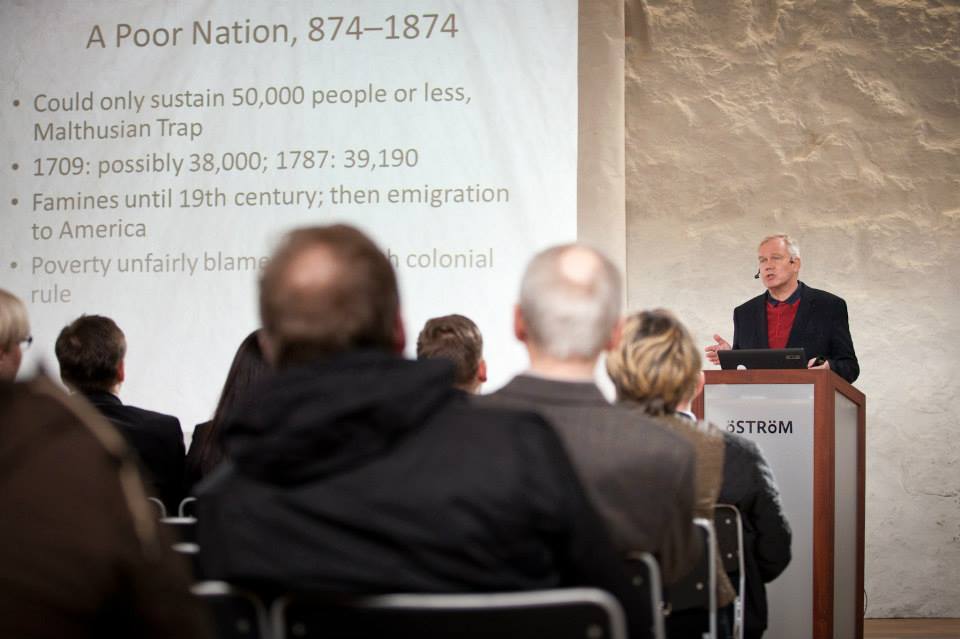
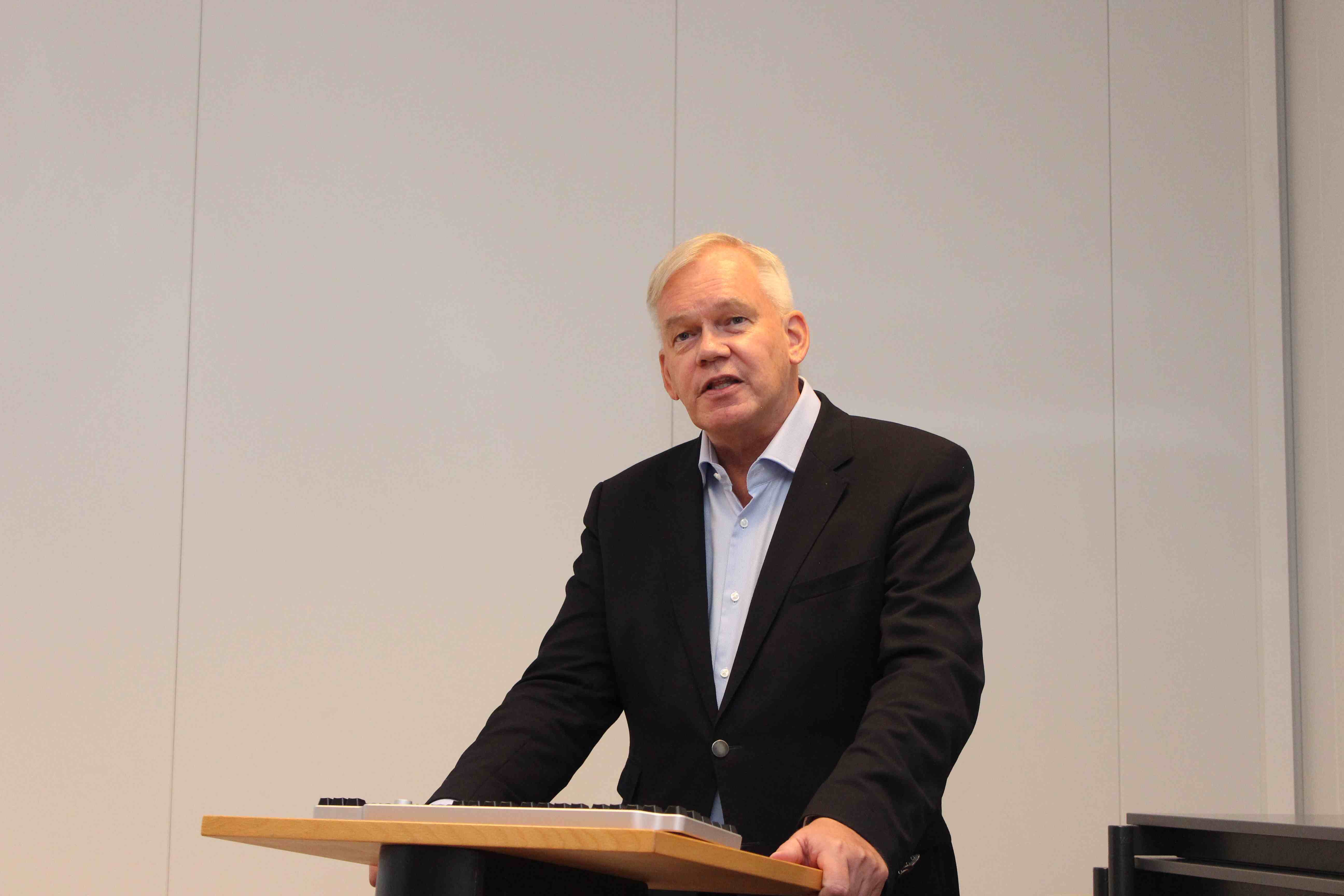
Gissurarson in the Hague 12 November. Photo: Karl Altau.

Professor Gissurarson also gave an outline of two lectures that he had held himself in connection with the project. First, he read a paper in November 2012 in defence of Jung Chang and Jon Halliday, authors of the famous biography, Mao: The Unknown Story. An Icelandic employee of the present Chinese dictatorship had published a long attack on their work in Saga, the journal of the Icelandic Historical Association, while the book was still being translated into Icelandic. The second lecture was delivered in October 2013 on “Different Nations — Shared Experiences”, where Professor Gissurarson compared the fates of Iceland and the three Baltic countries. They all became sovereign states in 1918; they were all occupied in the Spring of 1940, Iceland by the British, the Baltic countries by the Soviets; in all four countries, the foreign army based there was replaced by another one in the Summer of 1941, in Iceland by the US, and in the Baltic countries by the German Nazis; all four countries became republics in 1944, Iceland by severing the last ties to the Danish king, and the Baltic countries by being forced to become Soviet republics.

Seminar in the Hague 12 November 2013. Courtois 1st from left, Landsbergis 1st from right.

At the Platform annual meeting, Kurt Schrimm, director of the Central Office for the investigation of National Socialist Crimes, gave a guest lecture on the Demjanjuk case. In connection with the meeting, a seminar was held in the Huis De Boskant in the Hague, on the roots of totalitarianism. There, Stéphane Courtois pointed out that Lenin had been the first one to try the implement the totalitarian idea of a complete recreation of society and of a new man. In fact, Stalin and Hitler and even Mussolini had been his disciples in this regard. Other participants in the panel were Vytautas Landsbergis, former President of Lithuania and a MEP, Lázsló Tökes, Bishop of the Reformed Church in Romania, a prominent dissident under the communist regime and presently a MEP, and two Dutchmen, Jan Wiersma, former MEP for the Dutch Labour Party, and Professor Theo de Wit. In the discussion, Courtois reminded the audience of the dact that the church was the only significant force which opposed totalitarianism before the 2nd World War, as two 1937 papal encyclicals showed, Divina Redemptoris defending private property rights against communism, Mit brennender Sorge criticizing the German Nazi regime. In the discussion, Dr. Pawel Ukielski, a delegate to the Platform, said that the experience of Central and East Europeans was often overlooked in history books about the 2nd World War. For example, the war was not originally between the Axis powers and the Allied powers, since Hitler and Stalin had in their 1939 non-aggression pact divided Central and Eastern Europe up between the two of them, remaining allies until the Summer of 1941.

Gissurarson’s slides in the Hague

Comments Off

Gissurarson: Myths of the “Octopus” and “Fourteen Families”

Standard Oil: Illustration from 1904.

At a seminar in the Faculty of Business Administration 5 November 2013, Professor Hannes H. Gissurarson criticized the accounts on the Icelandic economy given by authors such as Roger Boyes, Robert Wade and Sigurbjorg Sigurgeirsdottir. Those people claimed that the economy had, for most of the 20th Century, been controlled by “Fourteen Families” or by an “Octopus”. The concept of the “Fourteen Families” originally came from El Salvador, that country being divided into fourteen regions, with a great contrast between a small class of landowners and the poor multitude. Iceland had however a relatively even distribution of income and was in many other respects very different from El Salvador. Some families had certainly been influential in Iceland in the 20th Century, such as the Thors Dynasty, the Engey Family and some merchant families. But powerful families had also existed on the left. Hermann Jonasson and his son, Steingrimur Hermannsson, of the Progressive Party had for example been Prime Ministers for a total of 17 years in the Century. Former Prime Minister Johanna Sigurdardottir was the daughter of a Member of Parliament for the Social Democrats and the granddaughter of a well-known trade union leader. Gissurarson pointed out that in this matter the causal connection might be different from what many believed. Perhaps families were renowned, because many individuals in them had had distinguished careers, rather than that they had had distinguished careers because they came from renowned families. The concept of the “Octopus” was also foreign by origin. It was used in early 20th Century about monopoly capitalism, but in Iceland it became a household word when the government broadcasting service in 1986–7 showed a television series on the Italian mafia called “The Octopus”. Journalists had seized the word and used it about a loosely-connected group of businessmen led by architect Halldor H. Jonsson. That group had however only controlled a few of the largest companies in Iceland, and only for a while: Many companies had been cooperatives, while others had been government enterprises, and some had been fishing firms or marketing associations for such firms.

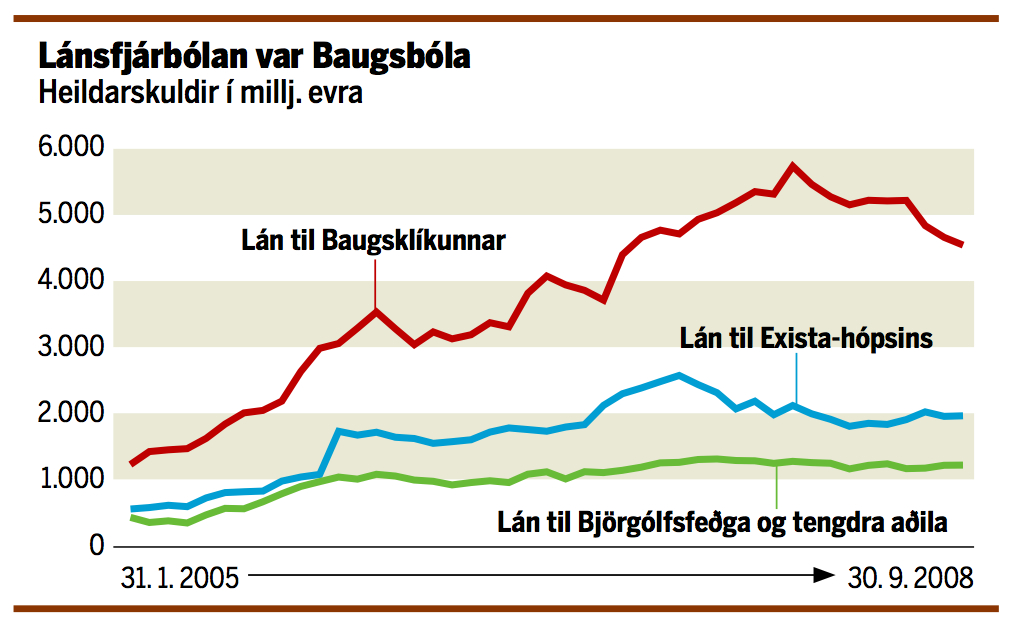
Loans to three major business groups 2005-9. Red line is Baugur clan. Green line is Bjorgolfur, father and son. Source: SIC report 210.

Professor Gissurarson discussed the claim that in Iceland the Octopus had been replaced by the Locomotive Group as a leading power elite at the end of the 20th Century. He said that the Locomotive Group had been idealistic in origin: It had been formed in 1972 to publish a cultural magazine, The Locomotive, while the editorial board had contined to meet for lunches forthnightly, after the magazine folded in 1975. This had been a diverse group: For example, two members of it, David Oddsson and Thorsteinn Palsson, had competed for the leadership of the Independence Party in 1991. The Locomotive Group had been an innocent luncheon group, not a power elite. Professor Gissurarson also rejected some theses put forward by Robert Wade and Sigurbjorg Sigurgeirsdottir about the Icelandic bank collapse in 2008. The collapse was not because of deregulation, because the legal and regulatory framework was precisely the same in Iceland as in other member states of the EEA, European Economic Area. However, the sound management of the economy in 1991–2004 had led to much confidence in the Icelandic economy and to very high credit ratings. This had been taken advantage of by a small clan of businessmen led by Jon Asgeir Johannesson of Baugur. When the report by the Special Investigation Commission of the Icelandic Parliament into the bank collapse was studied, it became clear that that Baugur Clan was in a class of its own in terms of borrowing. Other business groups, such as the Exista people and the Bjorgolfur father and son, had been more cautious. Professor Gissurarson pointed out that in another way the Baugur clan was in a class of its own: It bought up the private media in Iceland and used it to attack those whom it considered its enemies. Professor Gissurarson concluded by saying that the tiny population of Iceland was both a problem and an opportunity.

The seminar was well-attended, although Professor Gissurarson remarked that he missed some of the authors whose statements he criticized, having specially invited them to respond to his criticisms. A member of the audience, Bjorn Bjarnason, former Minister of Justice (2003–2009) and of Education (1995–2002), blogged about the talk. The online edition of Morgunbladid published an interview with Professor Gissurarson on his message.

Comments Off

Mitchell: Special Taxes on the Rich Counterproductive

Photo: Haraldur Gudjonsson.

Special taxes on the rich are counterproductive, according to Dr. Daniel Mitchell, senior tax analyst at Cato Institute in Washington DC. He argued for this at a well-attended seminar organised by the Icelandic Taxpayers’ Association and RNH in Reykjavik 4 November 2013. Mitchell pointed out that ordinary people on fixed salaries and with fixed hours could do little about it if their income tax was raised. But rich people usually derived their income from other sources, such as investment and management of private companies. If the tax on their income was  raised, they had many means to avoid paying more tax. A horde of lawyers and accountants were at their disposal. Thus, many kinds of economic distortions were created by a progressive income tax or other kinds of special taxes on the rich. One example given by Mitchell was that some rich people in the United States bought municipal bonds because income from them was tax-free. But this was not necessary the most productive use of their money for society in the long run.

Mitchell reminded his audience that Ronald Reagan had cut taxes on the rich, with the consequence that their number had increased considerably and also the tax revenue from them. He discussed the Laffer Curve which shows that tax revenue is zero at a 0% tax rate and again zero at a 100% tax rate. Observing that there was no controversy about this, Mitchell said that the issue was where on the curve the revenue-maximising point was. Paul Krugman and other dirigiste economists believed that the point was about 70% for taxes on the rich, but their analysis had been contested by economist Alan Reynold. Mitchell said that he himself believed that the point was closer to 20%. However, the objective ought not to be to maximise tax revenue, but rather to maximise economic growth in the long run, and to do so the tax rate had to somewhere around or under 20%. A lively discussion followed Mitchell’s lecture, where the special temporary wealth tax imposed by the left-wing government of Johanna Sigurdardottir and Steingrimur J. Sigfusson was mentioned, and also the special charge on the fisheries aimed at seizing the profits of fishing firms.

While in Iceland, Mitchell blogged about the Icelandic situation, recommending that at least government should freeze its expenditure. In a recent video, he delivered the same message as in Iceland about taxing the rich:

Comments Off

Brook: Nothing Wrong With Self-Love

Photo: Haraldur Gudjonsson.

Dr. Yaron Brook, director of the Ayn Rand Institute in California, gave a paper on self-love and capitalism in Reykjavik 1 November 2013, on the occasion of the publication of the Icelandic edition of We the Living, the most autobiographical of Rand’s novels, called “Kira Argunova” in the translation. According to Brook, in her novels Rand described the independent, creative individual who was proud of herself and determined to fulfil her potential as a rational human being. The real opposites in life were the free and spontaneous development of free individuals under the law on one hand, and government coercion in the other hand. In Western philosophy, Aristotle came closest to Rand in this ideal or moral goal. Self-love in Rand did not mean aggression towards others. However, the proud and independent individual in Rand—often a woman, for example Kira Argunova in We the Living and Dagny Taggart in Atlas Shrugged—refused to sacrifice herself for others. She was working for herself, not for others. Capitalism was the economic order under which people could develop and flourish in all their diversity without violating the rights of others or having their own rights violated.

A lively debate followed Dr. Brook’s speech. He was asked about charity in a Randian world. He responded that people could help and love others, but that the recepients had to deserve it. The social ills that most people were concerned about, such as poverty, were not remedied by charity, but by production. Only a fraction of the population could not look after themselves, but in a free society sufficiently many would want to help them, and they could do so because of capitalism. Brook said that he had nothing against charity, at your own expense. Brook was also asked whether he did really equate whipping a slave’s back and regulating the financial market. His answer was that the essential distinction was between coercive and non-coercive actions. Individuals should take responsibility for their lives, and government should not relieve them of that responsibility. Professor Hannes H. Gissurarson who chaired the meeting observed that in Icelandic a distinction was made between two senses of pride, “dramb” on the one hand, one of the seven deadly sins in Christianity, and “stolt” which had a positive ring to it. Rand’s ideal of the proud and independent individual was better captured by the latter of these two words, “stolt”.

We the Living appeared as a serial story in Morgunbladid in 1949, but the translator is not known despite attempts to locate him or her. Radio host Frosti Logason edited the book, and lawyer Asgeir Johannesson wrote an afterword about Rand, her life and her work. Morgunbladid published an interview with Brook 6 November 2013. Many left-wing intellectuals have blogged against Rand, for example television host Egill Helgason, philosophy Professor Stefan Snaevarr and sociology Professor Stefan Olafsson. Also, social democratic commentator Sigurdur Holm criticized Rand on the radio show “Harmageddon” 31 October 2013. A day after the meeting, Brook wrote on his Facebook page: “Gave talk yesterday. Toured country last couple of days. Very beautiful, dramatic landscape. In spite of cold and wind, had a really good time!”

Brook’s lecture, with the trailer from the Italian film made in the 1940 from We the Living, prohibited by Mussolini, and discussion after the lecture, is available on Youtube:

Comments Off

Gunnlaugsson: Special Charges in Fisheries Unconstitutional

Gunnlaugsson giving his lecture.

At a well-attended meeting of Logretta, the Association of Law Students at the University of Reykjavik, 29 October 2013, former Supreme Court Judge Jon Steinar Gunnlaugsson argued that special charges imposed on the Icelandic fisheries were unconstitutional and therefore illegal. It was obvious, he said, that those charges were taxes by nature, so that rules applying to taxes would extend to them. The charges were laid on the holders of the individual transferable quotas which had been developed in the 1980s in order to limit access to the Icelandic waters. Gunnlaugsson said that as early as 1995 he had himself pointed out that such quotas were protected by the constitutional statute about private property. Gunnlaugsson said that both the general charge and the special charge imposed recently on the fisheries were unconstitutional. This was an illegal appropriation or seizure by government of private property. Moreover, those taxes were by their nature also retroactive.

The other lecturer at the meeting, Helgi A. Gretarsson, Associate Professor of Law at the University of Iceland, disagreed that all special charges on the fisheries were unconstitutional. He pointed it that there were clear provisos in the law on the individual transferable quotas that they did not form property rights and also that courts had insisted on the same principle, for example in three Supreme Court judgements, in 2000, 2012 and 2013. Gretarsson agreed however with Gunnlaugsson that the recent special charge on the fisheries was of doubtful legality. It could be in breach of articles 40 and 77 of the Icelandic constitution. Gunnlaugsson’s response was that the court judgements that Gretarsson had referred to had not really been on the nature of the individual transferable quotas, but about other issues; therefore, they did not have any general implications in this legal dispute. He said that the question which the Icelandic courts had to answer was the following: Is it constitutional that the Icelandic government seizes, with the imposition of special taxes, all or most of the profit being generated in the fisheries?

Many distinguished lawyers and business leaders attended the meeting, as well as students at the University of Reykjavik. While Logretta held it, RNH supported it as forming a part in the joint project with AECR, the Alliance of European Conservatives and Reformists, on “Europe, Iceland and the Future of Capitalism”.
Comments Off

Gissurarson: Iceland Out in the Cold

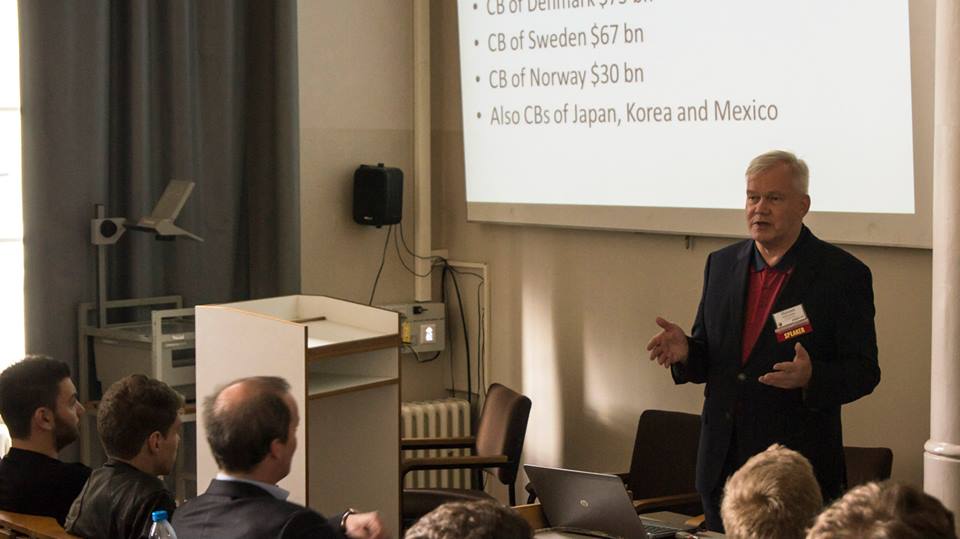
Professor Hannes H. Gissurarson gave a lecture on the Icelandic bank collapse and the future of capitalism at a breakfast meeting of the Swedish think tank Timbro in Stockholm Tuesday 29 October 2013. Sharing the podium with him was Urban Bäckström, former Governor of the Swedish Central Bank and now Director of the Employers’ Association. Gissurarson argued that the international financial crisis had essentially three causes: 1) excessive risk-taking stemming from the unwritten rule that profit is captured by bankers, while loss is transferred to taxpayers; 2) misguided government intervention, for example in the subprime loan market in the US and in the expansionary pre-crisis policies of the American Federal Reserve System; 3) incorrect pricing of risk despite a belief to the contrary, based on new financial techniques. Professor Gissurarson observed that capitalism still seemed to be subject to what used to be called business cycles.

Professor Gissurarson rejected the common claim that the Icelandic bank collapse had been caused by a “neoliberal” legal and regulatory framework for the Icelandic financial market: the framework was precisely the same as in other member countries of the EEA, European Economic Area. He also rejected the claim that Icelandic bankers had been more reckless than their colleagues elsewhere: all bankers had been reckless. Otherwise it would not have been necessary to bail them out in the US and Europe at enormous costs to American and European taxpayers. The Icelandic banks had not been too big when looked at as European banks: But they were certainly too big to depend on institutional support from Iceland alone. What happened in the crisis was  however that all other countries, for example Switzerland, were helped with large currency swap agreements with the American Federal Reserve System, while Iceland alone was refused such an agreement.

Urban Bäckström said that capitalism had not failed despite the financial crisis. He reminded the audience of the fact that Sweden had suffered a severe banking crisis in the early 1990s, when an asset bubble had burst and the Swedish krona had tumbled down. They had come out of the crisis successfully. Government had saved the banks, but removed the equity from the owners of banks needed saving, while protecting the interests of depositors and creditors. In his comment on this, Professor Gissurarson said that the Swedish scheme of coping with a banking crisis was a sensible one, but that the Icelanders had not been able to implement such a scheme because they lost total control of the situation when the British Labour government suddenly closed the two Icelandic banks in England, at the same time as it presented a huge rescue package to all other banks in the country, and then, to add insult to injure, when the Labour governemtn also put one of the Icelandic banks on a list of terrorist organisations, causing an immediate stop to all financial transactions to and from Iceland.

The meeting was well-attended, and a sympathetic, if cricital commentary of Gissurarson’s paper was published in Dagens Nyheter, Sweden’s biggest quality newspaper. A tape of the meeting, with the lectures and the discussion afterwards, is available on Youtube:

Comments Off