
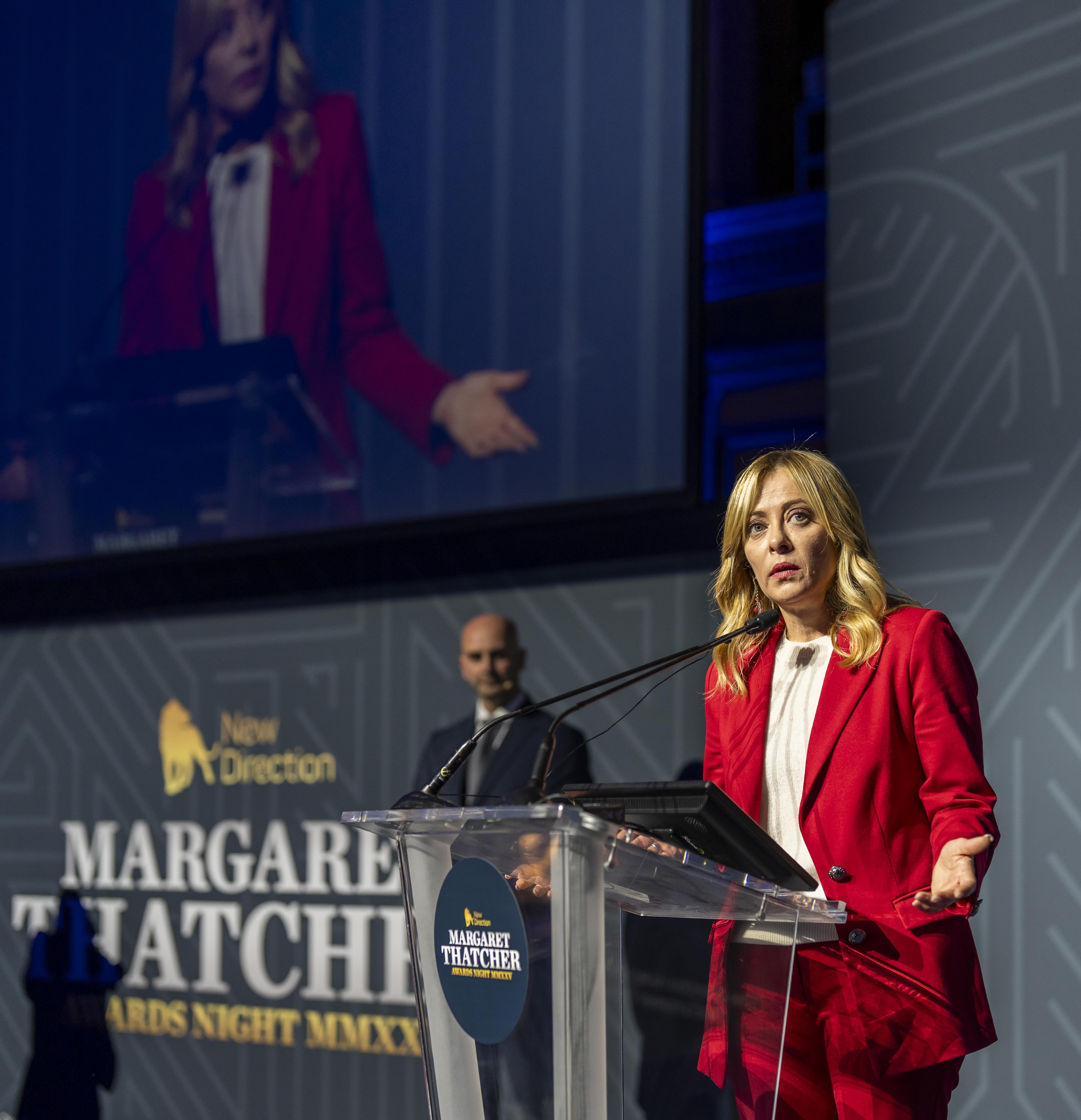
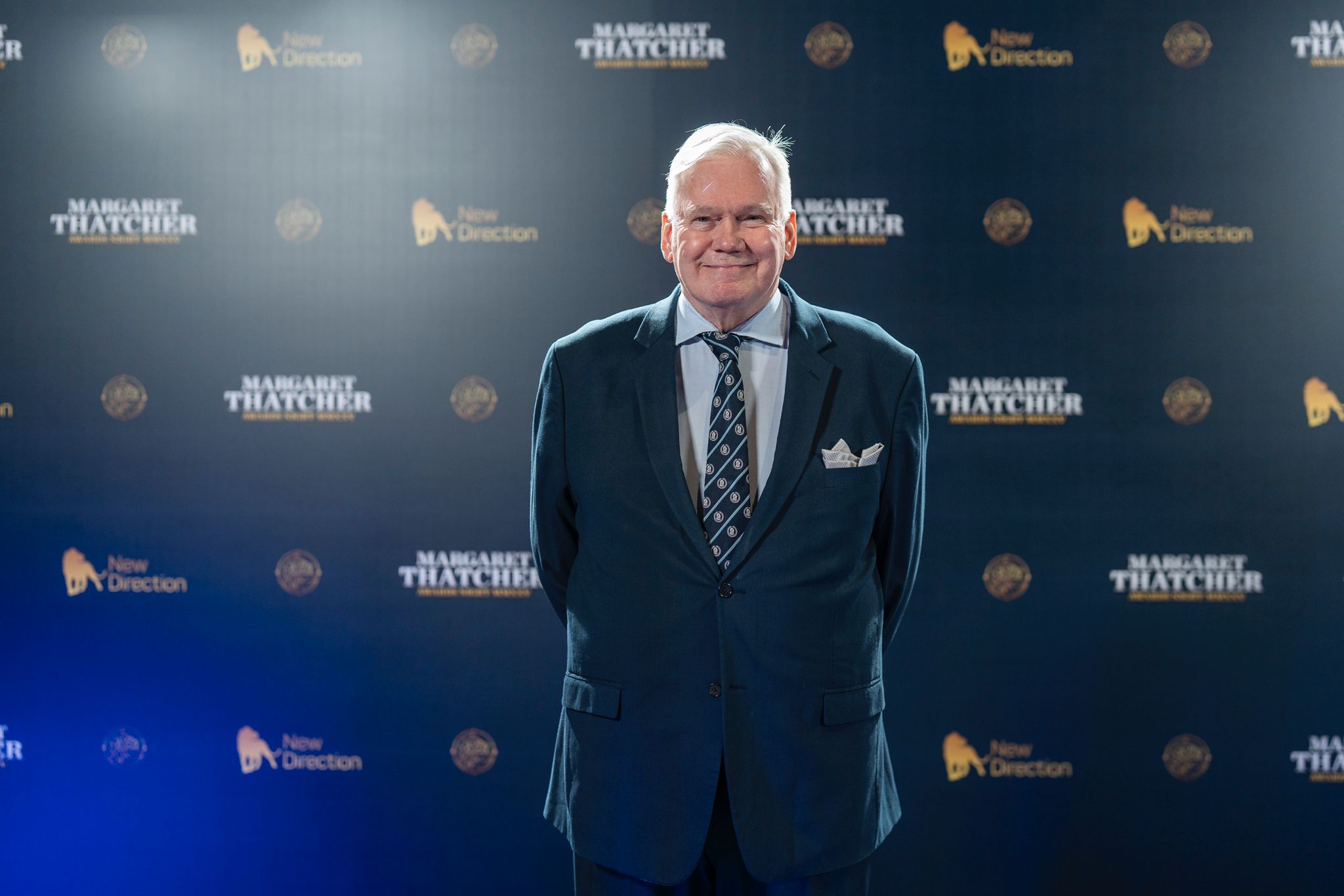
 The Brussels think tank New Direction held a dinner in Rome on 11 December 2025, during which the Margaret Thatcher Awards were presented. Italian Prime Minister Giorgia Meloni received one of the awards and made a powerful speech in English about her ideas and inspirations, without any notes. Unquestioningly, Meloni is becoming the leading European conservative politician. RNH Academic Director, Professor Emeritus Hannes H. Gissurarson, attended the dinner and wrote two articles in The Conservative about it.
In the first article, Hannes commented on the names on a board at the entrance, each the nominal head of a table at the dinner. They gave a good idea of who inspires the contemporary conservative movement. There were six politicians on the list: British Prime Minister Margaret Thatcher, U.S. President Ronald Reagan, Polish President Lech Kaczyński, German Chancellor Konrad Adenauer, Australian Prime Minister John Howard, and Polish Marshal and Prime Minister Józef Piłsudski. Two other individuals on the board, Pope John Paul II and American writer William Buckley, might perhaps also be considered politicians. Hannes wrote that he had only met one of the eight, Thatcher, several times.
The writers in the group were Joseph de Maistre, Roger Scruton, Friedrich von Hayek, Edmund Burke, Giuseppe Prezzolini, Giacomo Leopardi, Milton Friedman, Benedetto Croce, Ludwig von Mises, Thomas Sowell, Alexis de Tocqueville, Mihai Eminescu, and Alessandro Manzoni. Hannes admitted that he had never before heard of Prezzolini and Eminescu, but that he was familiar with the works of Maistre, Burke, Leopardi, Croce, Mises, Tocqueville, and Manzoni. He had briefly met Scruton and Sowell at conferences, but he had been fortunate enough to get to know Hayek and Friedman quite well. He had arranged their visits to Iceland: Hayek came in 1980 and Friedman in 1984, and they both made a great impact. Personally, he would have liked to see Luigi Einaudi on the board rather than Benedetto Croce, and he regarded Maistre more as a reactionary than a real conservative.
 The second article was about three Icelanders who had travelled to Rome. The first was Gudrid Thorbjornsdaughter, who led a remarkable life. Born in Iceland, she went in the 990s to Greenland, where she married. She and her husband went to what is now called North America in 1008 and tried to settle there. She gave birth to a son in America, the first child of European descent in America. Later, the family returned to Iceland and settled there. After Gudridur became a widow, she went on a pilgrimage to Rome around 1030. She was probably the most widely-travelled individual of her time. The second traveller to Rome was the poet Einar Benediktsson in 1903. He composed the poem ‘An Evening in Rome’ where he contrasted the glory of the Roman Republic with the corruption under the emperors, but also marvelled at the great cultural heritage the Romans left. The third traveller was Jón Thorláksson in 1923, on a belated honeymoon with his wife. He was a civil engineer who eventually became Iceland’s prime minister and leader of the conservative-liberal Independence Party. As he looked at the ruins of the Forum Romanum, he was on the verge of tears at the destruction of the once-proud city. Hannes H. Gissurarson wrote the biography of Jón Thorláksson, published in 1992.
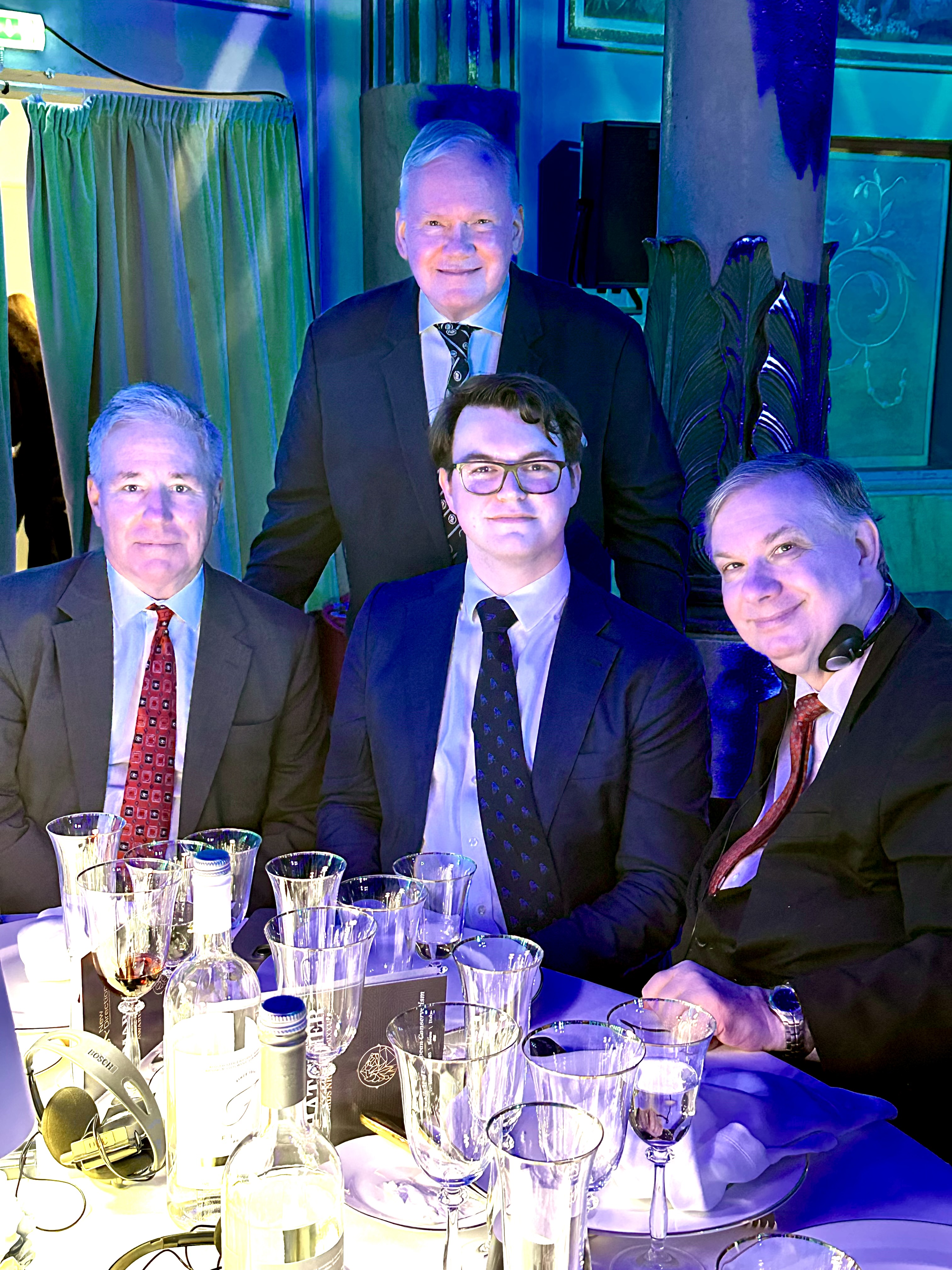
From left: Mitchell, Hannes, Tyler, and Fund.
At the dinner, Hannes was seated with three friends of Iceland who have often visited, Robert Tyler of New Direction, John Fund of National Review, and Dr. Dan Mitchell of Freedom and Prosperity Foundation. Others winners of the Margaret Thatcher Awards included Sviatlana Tsikhanouskaya, Leader of the Belarus opposition, Lord Michael Gove and French philosopher Rémi Brague. In Rome, Hannes also met with Sigmundur Davíd Gunnlaugsson, Chairman of the Icelandic Centre Party, and representatives of the Party’s youth wing that were attended a training camp run by Giorgia Meloni’s party, Fratelli d’Italia. The Centre Party is probably going to join the European Conservatives and Reformists, ECR. Previously, the Independence Party was a member, but it now has left the ECR and joined the European People’s Party, EPP. Hannes, Sigmundur Davíd, and the young Centre Party people had a good time in Rome, at the historic Harry’s Bar on Via Veneto and in other places.
