

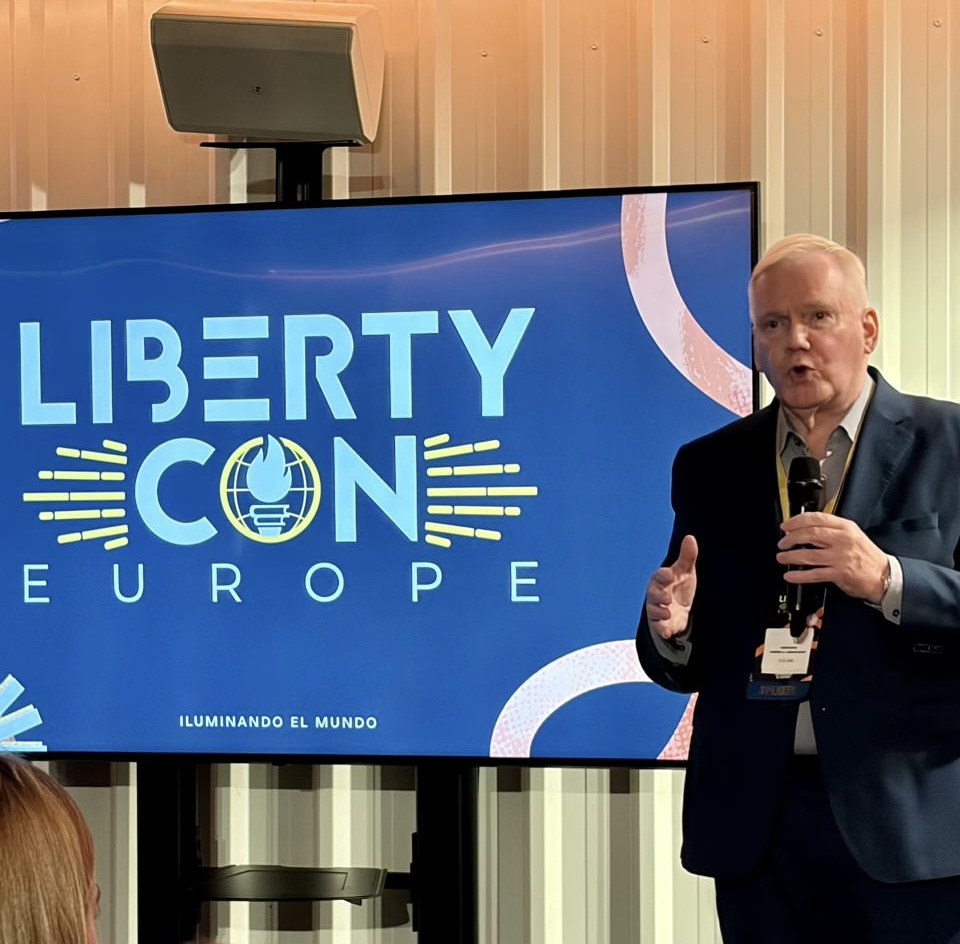
 European Students for Liberty held their annual conference, LibertyCon, in Madrid on 24–26 April 2026, where RNH Academic Director, Hannes H. Gissurarson, Professor Emeritus of Politics at the University of Iceland, presented a new book that he has edited and introduced, Conservative-Liberal Thought in the Nordic Countries, 946–1945: An Anthology. It is 468 pages long, of which Hannes’ introduction is 267 pages. It was published by the think tank New Direction in Brussels.
The book’s first selections are from the writings of Icelandic historians Ari the Learned and Snorri Sturluson. In a famous speech at the Icelandic Parliament in the year 1000, the Lawspeaker, Thorgeir from Brightlake District, emphasised, according to Ari the Learned, that the Icelanders had no king but the law, unlike the other Nordic nations where kings waged endless wars and imposed heavy taxes. The same theme was found in Snorri’s account of another famous speech, by the farmer Einar from Thverá at the Parliament in the year 1024. In Snorri’s Heimskringla, the history of the Norwegian kings, two ancient Germanic principles are taken for granted: government by consent and the right of rebellion. Later, the English philosopher John Locke built a systematic defence of liberty on those two principles.
Hannes said that the three most remarkable Nordic conservative-liberal thinkers were Snorri, the Swedish pastor and politician Anders Chydenius, and the Danish pastor and poet N. F. S. Grundtvig. In 1765, Chydenius had anticipated the two powerful ideas articulated eleven years later in Adam Smith’s Wealth of Nations: that one man’s profit need not be another man’s loss; and that order could arise spontaneously, without commands. In the nineteenth century, Grundtvig had argued, much in the same manner as the French writer Alexis de Tocqueville, for free associations that could serve as both guardians and outlets for individuals, such as congregations, people’s high schools, various societies, collectives, cooperatives, and private companies.
The audience included the Icelandic Ambassador to Spain, Kristján Andri Stefánsson, and a lively discussion followed Hannes’ talk. The Czech student Jonáš Kurus asked about the connection of religion to the Germanic political tradition. Hannes replied that the roots of Germanic tribal self-government were pre-Christian, just as the Roman chronicler Tacitus had described in the first century AD. Admittedly, a principle of Roman law was that what affected all should be decided by all, Quod omnes tangit ab omnibus approbetur, but this had not been a general principle as in the customary law of the Germanic tribes. However, St. Thomas Aquinas accepted the right to rebel if and when kings became tyrants. Natural law in the Thomist tradition certainly had acted as a restraint on kings, but not to the same extent as Germanic customary law.
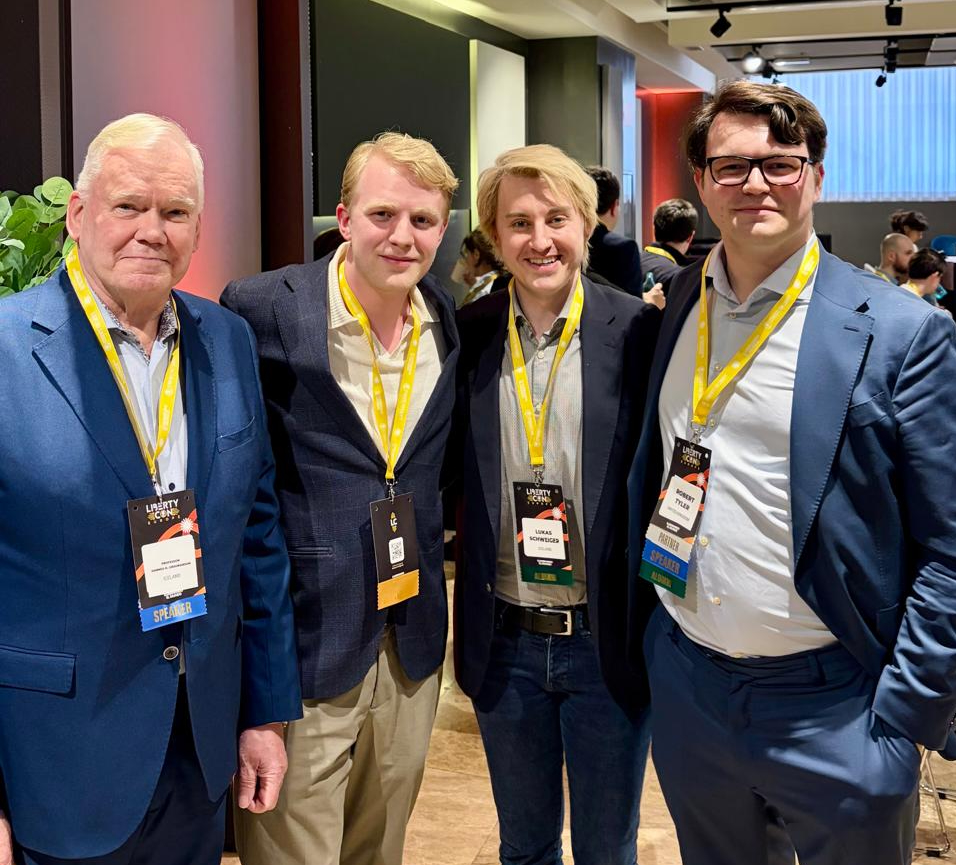
From left: Hannes, Breki, Schweiger and Tyler.
The German student Anne Struffmann asked what other nations could learn from the Nordic example. Hannes replied that the relative success of the Nordic countries was not because, but in spite of, social democracy. The Nordic heritage of liberty had been strong enough to withstand both the past assaults by kings invoking the grace of God and the modern assaults by social democrats invoking the will of the People. The success of the Nordic countries rested, Hannes said, on three pillars: the rule of law, including strong protection of private property rights, free trade, and social cohesion, which implied a robust civic spirit. But such a social cohesion could not be constructed. It developed over a long time, through compromises and mutual adjustments. Nevertheless, newly liberated nations in the South could learn from Grundtvig to try and transform peasants into responsible citizens and the masses into self-conscious nations by means of people’s high schools.
Other speakers at the conferences included three friends of Iceland who have often visited: Professor David D. Friedman, Dr. Tom G. Palmer 0f the Atlas Network, and Robert Tyler of New Direction. They have all studied the Icelandic chronicles and sagas. The conference was attended by two other Icelanders, Lukas Schweiger, former Chairman of European Students for Liberty, and Breki Atlason, the Icelandic coordinator of European Students for Liberty.
