Green Capitalism

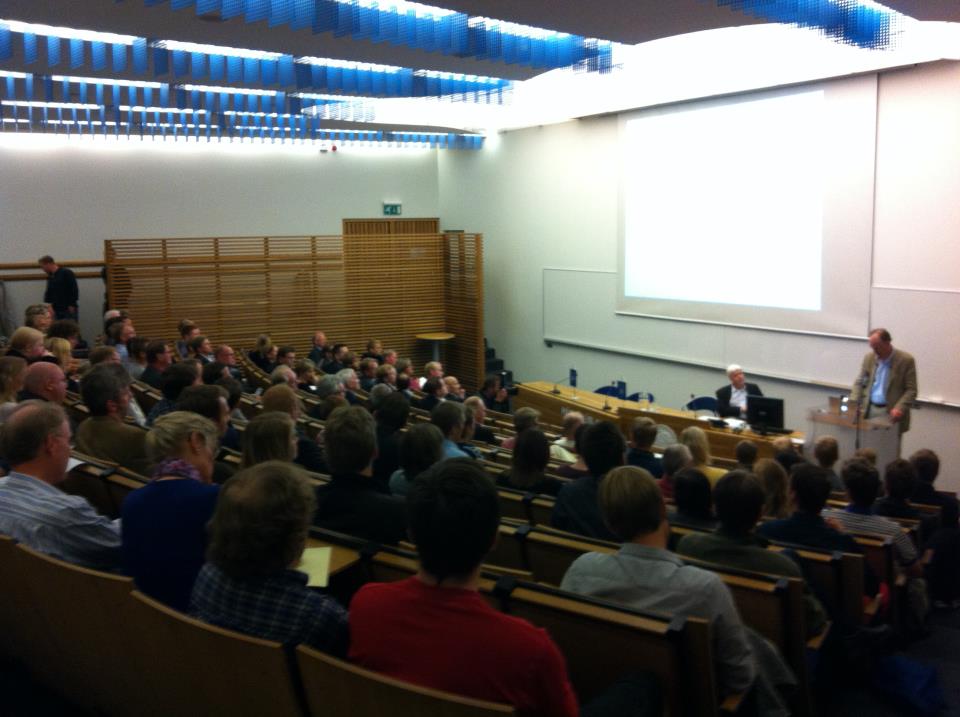
Professor Ragnar Arnason speaks at the fisheries conference 6 October 2012. Asta Moller in the chair. Photo: Haraldur Gudjonsson.

An important part of the project jointly organised by RNH and ACRE, the Alliance of  Conservatives and Reformists in Europe, on “Europe, Iceland and the Future of Capitalism” is the exploration of reforms of institutions governing the utilisation of natural resources and protecting the environment. How can “green capitalism” be designed and implemented?

The first event on this theme was a lecture 27 July 2012 by British science writer Dr. Matt Ridley where he gave an outline of his argument in the best-selling The Rational Optimist. Another important event on this theme hosted by RNH in 2012 was an international conference on “Fisheries: Sustainable and Profitable” 6 October 2012. Speakers included Arni Mathiesen, director of the fisheries section at FAO and former Icelandic Minister of the Fisheries, Dr. Gunnar Haraldsson, chief fisheries expert at the OECD, Michael Arbuckle, chief fisheries expert at the World Bank, Professors Thrainn Eggertsson, Ragnar Arnason, Asgeir Jonsson, Birgir Thor Runolfsson and Helgi A. Gretarsson, all of the University of Iceland in Reykjavik, Professor Michael De Alessi from Stanford University and Professor Rognvaldur Hannesson of the Norwegian School of Economics and Business in Bergen. Editor Brian Carney from the Wall Street Journal Europe did a summing up. More information on the speakers is available here.

Leading fishing firm owner Gudrun Larusdottir, with her husband, Agust Sigurdsson. Photo: Haraldur Gudjonsson.

The next event in this part of the NRH-AECR project, the exploration of institutions of green capitalism, was a lecture Professor Hannes H. Gissurarson gave at the University of Iceland 26 October 2013 on what “Political Economy can tell us about the Money Smell”—referring to the odour emitted from fish smelting plants in Iceland often called “money smell”. Professor Gissurarson analysed air pollution such as “money smell” in terms of both Pigou’s and Coase’s theories and discussed different remedies.

Professor Gissurarson directs a research project at the University of Iceland on green capitalism, in co-operation with the Brazilian Instituto Millenium, based in Rio de Janeiro. In connection with the Rio+20 international conference on the environment, RNH and the California-based Reason Foundation held an informal seminar in Rio de Janeiro, 19 June 2012, with talks by Julian Morris and Hannes H. Gissurarson. In connection with the seminar, there was a reception on Iceland’s national holiday, 17 June, attended by some Icelanders, including Arni Mathiesen.

In 2013, Professor Hannes H. Gissurarson participated in the Mont Pelerin Society regional conference on liberty and evolution on the Galapagos Islands 22–29 June, as a part of the research project on green capitalism. He chaired a session on  liberalism and Darwinism.

From left, first row: Kristjan Loftsson, Ralph Townsend, Hannes H. Gissurarson, Dadi M. Kristofersson, Gunnar Haraldsson. Photo: Omar Oskarsson.

On 14 October 2013, a conference to honour late Professor Arni Vilhjalmsson, both an academic and an entrepreneur in the Icelandic fisheries, was held at the University of Iceland, with Ralph Townsend, Professor of Fisheries Economics at the University of Main, giving the keynote speech. Other main speakers were Professors Ragnar Arnason and Hannes H. Gissurarson of the University of Iceland and Dr. Gunnar Haraldsson, director of the Economic Research Institute at the University of Iceland. The theme of the conference was “The System of Individual Transferable Quotas and the Demand for a Rent Resource Tax”.

In mid-October 2014 AB, the Public Book Club, published Matt Ridley’s book, The Rational Optimist, which in Icelandic is called Heimur batnandi fer, in a translation by Elin Gudmundsdottir, and edited by Hannes H. Gissurarson There, Ridley discusses various environmental problems and their possible solutions. Professor Thrainn Eggertsson made the following comment: “In his book Matt Ridley, writer, scientist, og former Economist senior editor, has rearranged ideas from Adam Smith and Charles Darwin in order to explain why man has done so much better than other animals on earth. How division of labour and exchanges between unrelated individuals have enabled us to utilise the knowledge of millions of people and create goods such as cars, computers and drugs, which none of use could have invented or produced on our own. Ridley also discusses mankind’s strong and dark pessimistic streak and some fashionable doomsday scenarios, formerly linked to religion, but now also to natural sciences. The author uses a wide basis of sources, has a superb command of English, peppered with a rich sense of humour, and he draws on an amazing wealth of knowledge on evolution of life on earth and the history of human beings and on new research in the social and natural sciences.”

Gísli Hauksson, RNH chairman, og Ridley, with the Icelandic edition of Ridley’s book. Photo: FOK.

On 24 October 2014, RNH held a seminar on resource rent tax, wealth tax and income distribution. Professor Corbett Grainger from the University of Wisconsin explained why a system of individual, transferable quotas was a better escape from “the tragedy of the commons” in fisheries than a resource rent tax. Professors Ragnar Arnason and Hannes H. Gissurarson explained why the case for a special confiscatory wealth tax was often based on a faulty methodology of measuring income distribution and morally assessing it. 30 October 2014, at a seminar jointly organised by RNH, AB Publishing and the finance company Gamma, Matt Ridley described the most important findings of his book, The Rational Optimist, while Economics Professor Thrainn Eggertsson discussed present trends in the information society and Associate Economics Professor Birgir Thor Runolfsson analysed one of Ridley’s examples of an institution leading to both sustainability and profitability, the Icelandic system of ITQs, individual transferable quotas, in the fisheries.

Prof. Hannesson speaks at the 2015 conference.

On 8 October 2015, RNH participated in a conference held by the School of Social Sciences at the University of Iceland in honour of Professor Rognvaldur Hannesson, an Icelandic economist living in Norway and a world authority on resource economics, who had recently published a trenchant critique of Ecofundamentalism. Dr. Dadi Mar Kristofersson, Head of the School of Social Sciences, and Professor Tor Einarsson, Chairman of the Economics Faculty, introduced Professor Hannesson who gave a keynote lecture, on which Julian Morris of Reason Foundation and Professor Bengt Kriström subsequently commented. In the evening, Illugi Gunnarsson, Minister of Education and Culture, gave a dinner in honour of Professor Rognvaldsson. In late 2015, the University of Iceland Press, supported by RNH, published a book by Professor Hannes H. Gissurarson, The Icelandic Fisheries: Sustainable and Profitable, where he described the Icelandic system of Individual Transferable Quotas, ITQs, in the fisheries and argued that the quotas should initially be allocated on the basis of catch history. The book is also available online. In 2016 Professor Gissurarson published a review of Professor Hannesson’s book in the Journal of Economics Library.

Gary Libecap gives his lecture at the 2016 conference.

In 2016, Professor Hannes H. Gissurarson gave several papers on a sustainable, profitable and equitable system in the fisheries, using the Icelandic ITQ system as a model: In Lima in Peru at the Fisheries Association 21 January and at the Ministry of Resources and Economics 26 January, and in Florence in Italy at an IEA seminar 8 September. On 29 August 2016, RNH participated in an international conference at the University of Iceland on rights allocation in the fisheries, and the idea of auctioning off quotas. The keynote papers were given by Professor Gary Libecap of the University of California at Santa Barbara and Professor Ragnar Arnason of the University of Iceland, followed with a panel discussion of Economics Professor Charles Plott, an international authority on auctions, Dr. Tryggvi Thor Herbertsson, Politics Professor Hannes H. Gissurarson and Associate Law Professor Helgi A. Gretarsson. Libecap and Arnason agreed that the most natural way of initially allocating fishing quotas was by “grandfathering” or catch history. Professor Plott pointed out that there was no need for auctions in the Icelandic fisheries, as there was a tolerably efficient system in place. Professor Gissurarson pointed out that the only right of which those who did not hold quotas had been deprived, was the right to harvest fish at zero profit, as the fisheries model of H. Scott Gordon had shown.

In October 2017, AB, the Public Book Club, in cooperation with RNH, published Progress by Swedish historian Johan Norberg (Framfarir in Icelandic) who argues that many environmental problems can be solved by new technology created by capitalism. Therefore, the environment and capitalism should be regarded as allies, not enemies. Norberg launched the Icelandic translation in a lecture at the University of Iceland 23 October. At the end of 2017, the Brussels think tank New Direction published a 69 pp. report, Green Capitalism, by RNH Academic Director Professor Hannes H. Gissurarson. On the basis of his analysis, he makes a lot of radical proposals, for example to start using DDT against malaria, adopt a system of individual transferable quotas in European fisheries, revoke the ban of harvesting those whale stocks which are plentiful, for example the fin and the minke whales in Icelandic waters, remove robust elephant stocks from the CITES list of endangered species and develop private property rights in them, held by local communities, and try and save the African rhino stocks—which in fact are endangered—by also developing property rights in them, held by local communities, wildlife park owners or individual farmers.

Comments Off

Professor Bent Jensen: They Served Moscow

Professor Bent Jensen in Iceland. Photo: Sigurgeir Sigurdsson.

Professor Bent Jensen, a distinguished Nordic expert on communism and author of many best-selling books in Danish, gave a lecture on Nordic Communism at a joint meeting of the University of Iceland Institute of International Affairs and Almenna bokafelagid 27 February 2012. This event was a part of a series of lectures organised in cooperation with AECR, the Alliance of European Conservatives and Reformists, on “Europe of the Victims: Remembering Communism”. In Iceland, as in Denmark, there has been a heated discussion on the nature and significance of the domestic communist movement. Were the leading communists agents of a foreign power or patriotic trade unionists? What was the nature of their ties with Moscow? Morgunbladid published an interview with Jensen 4 March, and the leading television host Egill Helgason discussed communism with Jensen (in Danish) on his weekly show on current affairs, transmitted 11 March. Jensen’s lecture is available here on Youtube.

From the Morgunbladid interview: The headline is “Lied for a Dream”.


Comments Off

Dr. Tom Palmer

Upon the publication of Ayn Rand’s Fountainhead, 28 November 2011, Dr. Tom Palmer of Cato Institute in Washington DC, gave a talk in the Icelandic House of National Culture on “21st Century Individualism”, followed by a reception hosted by Almenna bokafelagid. Palmer discussed Rand’s relevance today, in the light of the experience of capitalism and socialism, and the message in her main novels. Palmer was the keynote speaker the same night at a very successful “Freedom Dinner” at Hotel Holt where young entrepreneurs and intellectuals celebrated, under the guidance of asset manager Gisli Hauksson. Vidskiptabladid (The Journal of Commerce) published an interview with Tom Palmer 1 December 2011.

Comments Off

Goran Lindblad

Upon the publication of The Black Book of Communism in the Icelandic translation of Hannes H. Gissurarson, Goran Lindblad, former MEP from the Swedish Moderate Party, gave a talk in Reykjavik 31 August 2009. He discussed the declarations of the European Council in 2006 and of the European Parliament in 2009, for the need to disclose and to assess the crimes of communism and to remember its victims. The European Parliament has called for 23 August (the day when the non-aggression pact between Hitler and Stalin was signed in 1939) to be a European remembrance day for victims of totalitarian regimes. Bjorn Bjarnason, former Minister of Justice, chaired the meeting, and Jon Baldvin Hannibalsson, former Minister of Foreign Affairs, responded to Lindblad’s talk.

Comments Off