

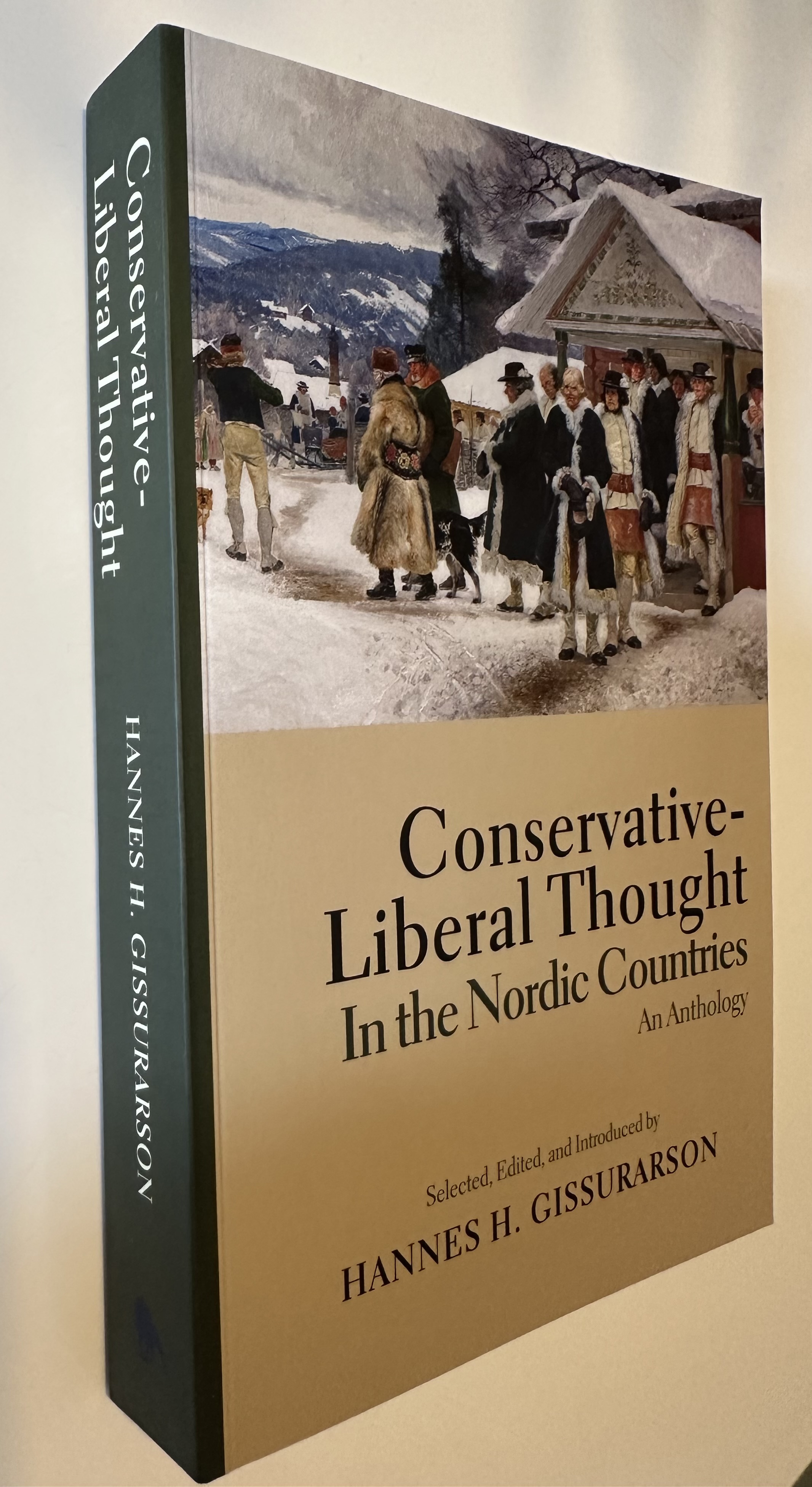
 On 26 April 2026, the Brussels think tank New Direction published a book, edited and introduced by RNH Academic Director, Hannes H. Gissurarson, Professor Emeritus of Politics at the University of Iceland, Conservative-Liberal Thought in the Nordic Countries 946–1945: An Anthology. The authors of the selections are the three Icelandic chroniclers Ari the Learned Thorgilsson, Snorri Sturluson, and an anonymous author of the ‘Tale of Halldór Snorrason’; the Danish bishop Gunnar of Viborg, author of the Preamble to the Law of Jutland; Danish King Eric Clipping (unwillingly), signatory to the royal charter of 1281; the Swedish bishop Thomas Simonsson, author of a poem on freedom; the Swedish polymath Olaus Petri, author of ‘Rules for Judges’; the Swedish pastor and politician Anders Chydenius, author of pamphlets in support of free trade and freedom of expression; the Swedish poet and professor of history Erik Gustaf Geijer, author of poems and essays on individual freedom and spontaneous order; the Danish pastor and poet N. F. S. Grundtvig, author of poems and speeches in support of liberal nationalism and civic education; the Swedish professor of economics Gustav Cassel, author of a forceful attack on central economic planning; the Danish professor of economics Jens Warming, a pioneer in resource economics and welfare economics; the Swedish professor of economics Eli F. Heckscher, author of a thoughtful critique of central economic planning; the Swedish law professor Nils Herlitz, author of an article on the Nordic legal heritage; the Danish law professor Poul Andersen, author of an article defending freedom of expression; and the Norwegian economist and journalist Trygve Hoff, arguing for the competitive economy.
The oldest event described in the book took place in 946, when Norwegian King Haakon the Good returned to his subjects the land that his father, King Harold Fairhair, had expropriated, and promised to uphold the ancient law of the land, which could be traced back thousands of years to the customary law of the Germanic tribes, as described by the Roman chronicler Tacitus. The most recent event was in 1945, when Danish communists tried to restrict freedom of expression just to those who accepted democratic values, while Poul Andersen recalled Grundtvig’s exclamation that freedom was for Loki as well as for Thor. Snorri Sturluson, Anders Chydenius, and N. F. S. Grundtvig contribute most to the anthology, which contains 468 pages, of which 267 pages are the introduction.
